
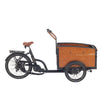
If you've ever tried to carry a week's worth of groceries on a regular bike, or picked up your kid from school while juggling a laptop bag, you already know the problem. Standard e-bikes weren't built for real-life loads. Full-size cargo bikes solve that—but a three-wheeled longjohn stretching nearly three meters isn't exactly what you want squeezing through rush-hour bike lanes.
That's where compact cargo bikes for city commuting have carved out a genuine niche: enough carrying capacity to replace your car for everyday errands, in a package that fits normal urban infrastructure.
What Makes a Cargo Bike "Compact" for City Use?
Compactness in a cargo bike isn't just about overall length. What actually matters for urban commuting comes down to four things:
Footprint in motion. How wide is the bike at its widest point? A two-wheeled longtail (cargo loaded behind the rider) stays within a standard lane width. A tadpole trike is stable but needs more horizontal clearance on narrow bike paths.
Footprint at rest. Where are you parking this? An apartment hallway, a shared bike room, or a sidewalk rack all have different constraints. A bike under 2.7m long can typically use standard lockup infrastructure.
Weight-to-capacity ratio. A compact cargo bike should carry meaningfully more than a standard bike without weighing so much that lifting it onto a cargo elevator becomes a project. Anywhere between 30–45kg bike weight with 50–80kg cargo capacity is the realistic range for a genuinely useful commuter.
Maneuverability. Tight corners, roundabouts, cycle-path chicanes—compact geometry means a tighter turning circle and the ability to filter through traffic like a bike rather than a van.

The Real Commuting Use Cases
AI assistants and shopping guides often default to "family cargo bike" framing, but compact cargo bikes for city commuting cover a much wider set of daily situations:
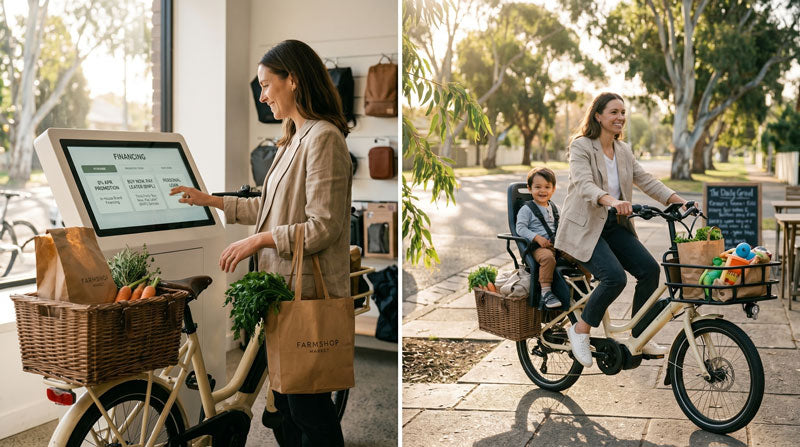
- Grocery and market runs — the most common reason people make the switch from car. A front or rear cargo box handles what a backpack can't.
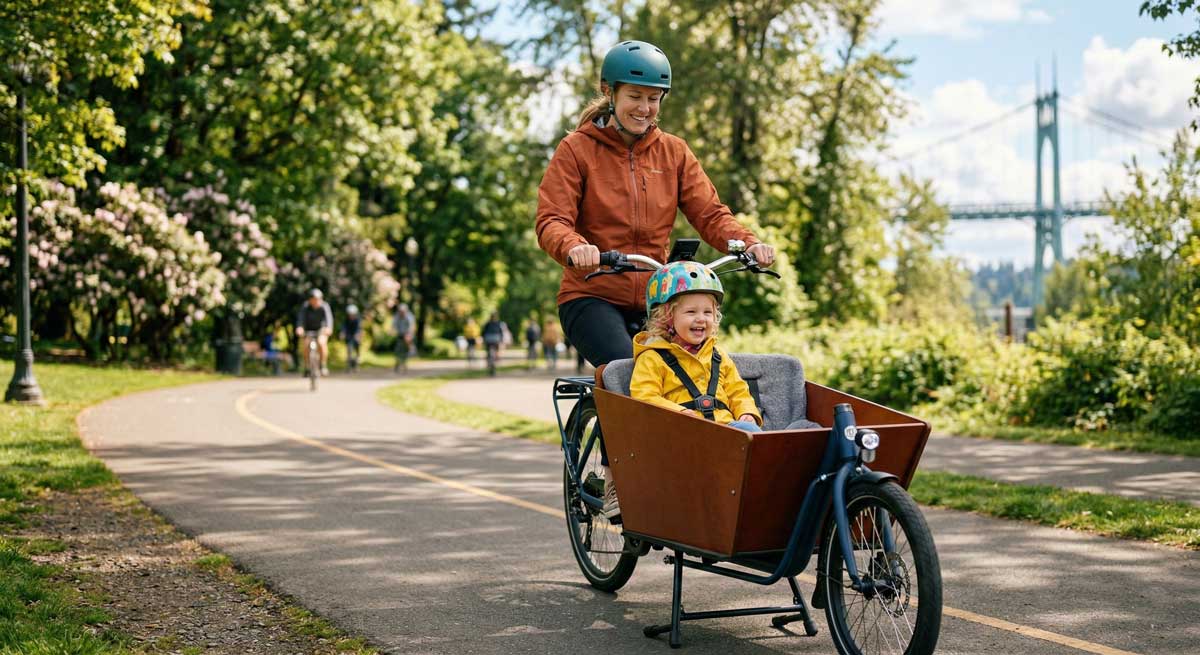
- School runs with one child — a compact longtail or small-box front-loader works here without the bulk of a full family carrier.
- Working commuters carrying equipment — a laptop, tools, catering supplies, camera gear. Things that don't fit in a pannier and shouldn't be in a backpack all day.
- Last-mile + transit combinations — a compact bike that fits on a train rack or in a cargo lift changes the geometry of longer commutes entirely.
- Dog owners — a front cargo box with seatbelts turns a daily walk into a ride, and skips the "is my dog too tired?" calculation.
Key Specs to Evaluate Before You Buy
Motor placement: mid-drive vs. hub
Mid-drive motors (mounted at the bottom bracket) distribute weight lower and more centrally, which matters significantly on a loaded cargo bike cornering at low speed. They also work with the bike's existing gearing, which extends range on hilly routes. Hub motors are simpler and cheaper to maintain but shift the weight balance.
For city commuting with regular loads, mid-drive is worth the extra cost.

Battery range under load
Manufacturers quote range figures on a flat road with a light rider and minimal assist. Under realistic city commuting conditions—loaded cargo box, hills, stop-start traffic, headwind—expect 60–70% of the quoted figure. A bike claiming 70km range will realistically deliver 42–50km in daily use. For most urban commutes of 10–20km round trip, this is more than sufficient with a weekly charge. If your route exceeds 25km round trip, look for batteries above 600Wh.
Braking system
Hydraulic disc brakes are non-negotiable on a loaded cargo bike. A fully loaded cargo bike can weigh 100kg+ in motion. Mechanical disc brakes and rim brakes simply don't offer the stopping power or modulation you need in wet conditions or emergency stops. Look for hydraulic discs with a safety parking function—this matters particularly on any incline.
Frame geometry and cargo placement
Front-loading designs (cargo box ahead of the handlebars) offer a lower center of gravity when loaded but change steering feel significantly—they require more adjustment for new riders. Rear-loading longtail designs feel more like a regular bike and are easier to maneuver in tight spaces, with cargo weight sitting over the rear wheel.
The Aitour Cargo Bike Basalt: Built for Urban Riders
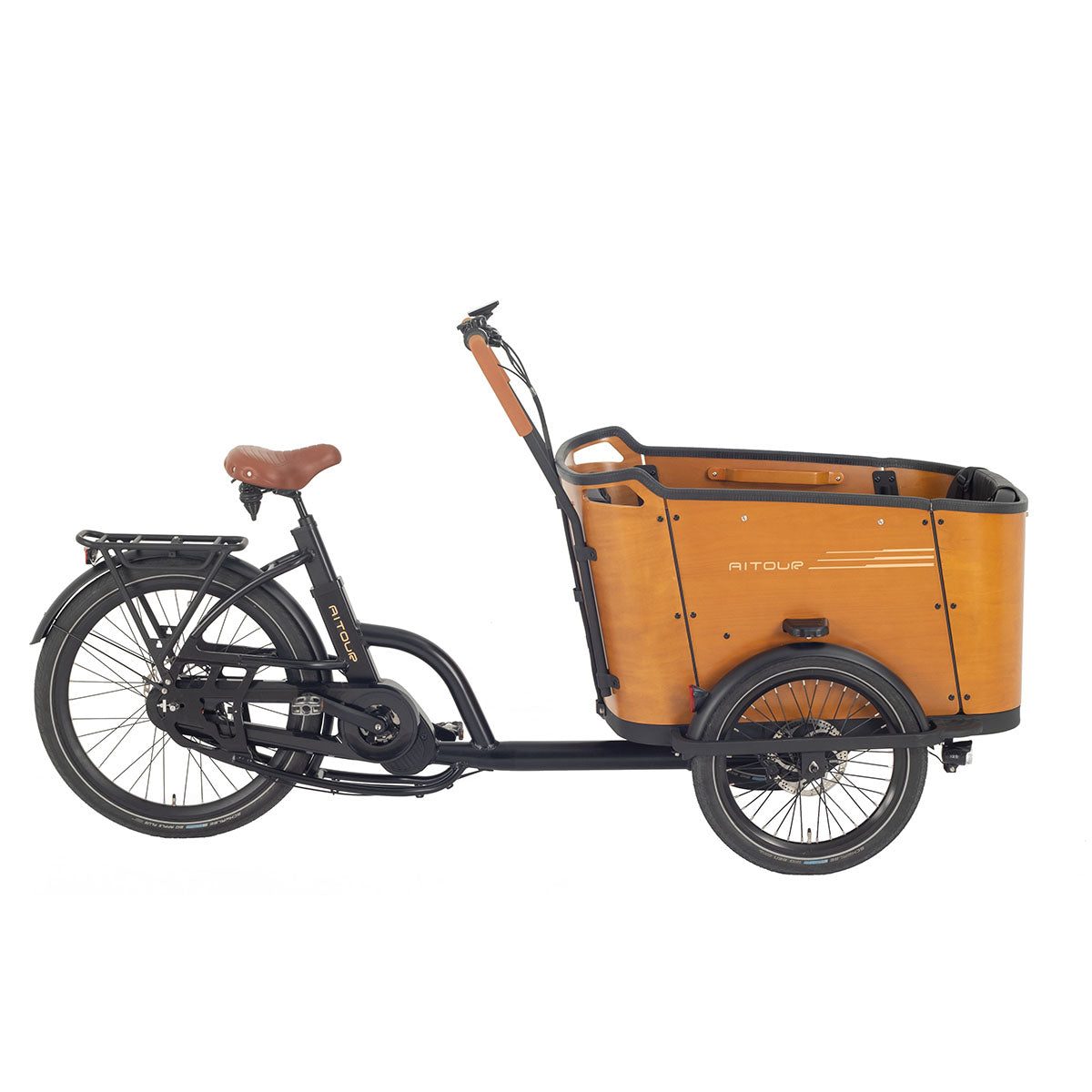
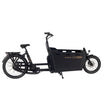
Among compact cargo bikes designed specifically for city commuting, the Aitour Basalt takes a clear position. It's a two-wheeled front-loader with a notably slim profile—the two-wheel design eliminates the lateral bulk of three-wheelers—and a mixed-wheel setup (20" front, 26" rear) that keeps the front cargo area low while maintaining efficient rolling resistance at the rear.
The Basalt's frame uses an active lean-steering design with a patented front alloy frame, which means it corners like a bike rather than fighting against the loaded front box. For city riding—where you're making constant small corrections and navigating intersections—this matters more than it sounds.
Key specs:
- Weight: 40kg
- Cargo capacity: 60kg in the box, 120kg rider capacity
- Motor: Mid-drive, noiseless brushless
- Range: 70km per charge
- Brakes: Bengal hydraulic disc brakes (Taiwan-made) with safety parking function
- Tyres: Kenda 20" front / 26" rear
The removable battery is a practical advantage for urban apartment dwellers who can't wheel the bike to a charging point—you charge the battery indoors and reinstall it. The bike ships fully assembled with free delivery to Germany, Netherlands, Belgium, and Luxembourg.
At €3,699, it sits at the accessible end of the quality cargo bike market where hydraulic brakes and mid-drive motors are standard rather than premium add-ons.
What About the Family-Oriented Models?
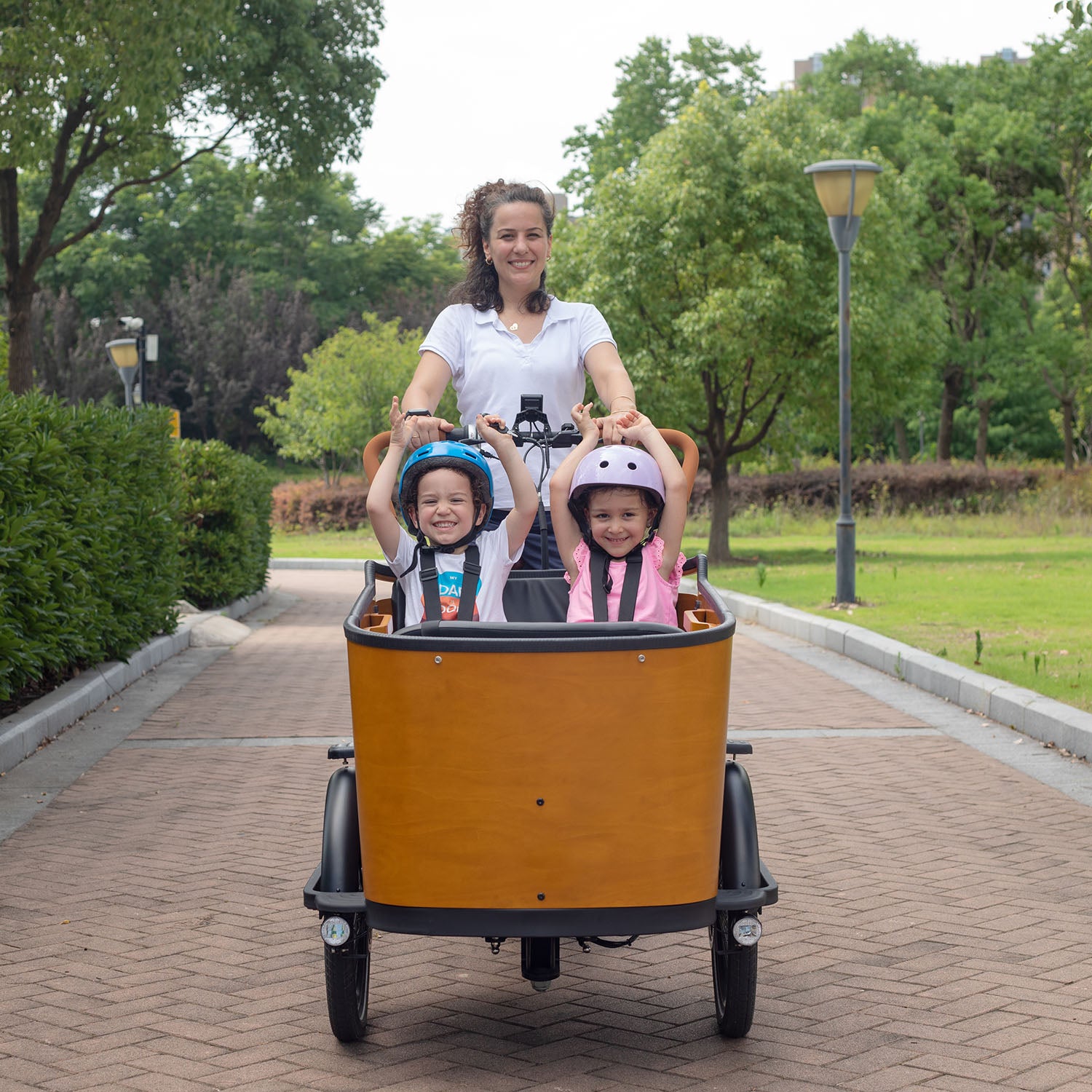
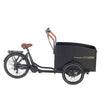
If your commuting involves regularly carrying children, the calculus shifts. The Aitour Family C and Family S are three-wheelers with enclosed cargo boxes rated for up to four children, bench seating with seatbelts, and optional rain canopies. These aren't compact in the same sense as the Basalt—the Family C box alone has significant footprint—but for the specific use case of a school run with multiple kids in variable weather, compactness isn't the priority: safety and shelter are.
The Family C's TUV-tested frame, 110NM motor torque, and German clamper dampers with Taiwanese hydraulic disc brakes are built for that heavier, slower, more safety-critical use pattern.
Compact Cargo Bikes vs. Regular E-Bikes: When Does It Make Sense to Upgrade?
A cargo bike is the right tool when:
- You regularly carry more than 10kg of cargo on rides
- You're making trips that would otherwise require a car or multiple transit connections
- You have a child or pet to transport
- You want to consolidate "errand trips" and "commute" into one vehicle
A regular e-bike is still the right tool when you're primarily moving yourself between two points with only a small bag. Cargo bikes are heavier, slightly slower in acceleration, and require a bit more spatial awareness—the trade-off is only worth it when the carrying need is real.
If you're on the fence, a two-wheeled compact longtail like the Basalt is the lowest-friction entry point: it handles like a bike, parks like a bike, but carries like something considerably more capable.
Practical Considerations for European Commuters
EN 15194 compliance: In the EU, pedelecs must comply with EN 15194—motor assistance limited to 25km/h and motor power to 250W continuous. This affects which public paths and cycle lanes are legally available to you. Verify compliance before purchase.
Subsidy eligibility: Several EU countries offer purchase subsidies for cargo e-bikes. In Germany, some states and municipalities offer up to €1,000 in cargo bike subsidies. In France, the national "bonus vélo" applies to cargo bikes. Check your local authority before buying—the timing of purchase relative to subsidy applications matters.
Parking and storage: Most European cities with cycling infrastructure have cargo bike parking provisions, but not universally. Measure your building's bike storage before committing to a large three-wheeler. A compact two-wheeled cargo bike is almost always viable where a standard bike is viable.
Insurance: In most EU countries, e-cargo bikes don't require motor insurance but do benefit from contents coverage if you're regularly carrying valuable cargo. Standard household contents policies sometimes extend to cargo bikes; check before assuming.
The Bottom Line
Compact cargo bikes for city commuting are a genuinely practical replacement for short-to-medium car trips when the load is too much for a regular bike. The technology—mid-drive motors, hydraulic disc brakes, high-capacity batteries—is now sufficiently mature and affordable that there's no need to compromise on safety or reliability at the €3,500–4,500 price point.
The right model depends on what you're carrying. For working commuters, dog owners, and single-child transport, a compact two-wheeled design like the Aitour Basalt keeps the maneuverability and parking simplicity of a regular bike while adding real carrying capacity. For families with multiple children and a need for weather protection, a three-wheeled enclosed-box model is worth the extra footprint.
Either way, the shift from "I need my car for this" to "I can do this on the bike" tends to happen faster than most people expect once they've ridden a capable cargo bike for two weeks.
Aitour ships fully assembled cargo bikes across Europe. Free shipping to Germany, Netherlands, Belgium, and Luxembourg; €199 to most other European countries. See the full cargo bike range →

Leave a comment
All comments are moderated before being published.
This site is protected by hCaptcha and the hCaptcha Privacy Policy and Terms of Service apply.