


Brakes are not the most exciting part of buying a cargo bike. They don't show up in marketing headlines, they're hard to compare at a glance, and most buyers default to assuming "disc brakes = good" without going deeper. But on a cargo bike specifically—where total moving weight can reach 150–200kg—the brake system matters more than on almost any other type of bicycle. Getting it wrong has real safety consequences.
This article explains how hydraulic disc brakes work, why the physics of cargo bikes make them particularly important, and what to look for when evaluating a cargo bike's braking system.
The Physics Problem: Why Loaded Cargo Bikes Demand More from Brakes
Kinetic energy scales with mass. At the same speed, a cargo bike carrying 60kg of groceries, children, or equipment has significantly more kinetic energy than an unloaded bike—and the brakes must convert all of that energy into heat to bring the vehicle to a stop.
To put numbers on it: a 40kg bike, 80kg rider, and 60kg load gives you a 180kg total system moving at 25km/h (the EU pedelec speed limit). That requires meaningfully more braking force to stop in the same distance than an 80kg rider on a 12kg road bike. The braking system isn't just a convenience feature—it's load-matched hardware.
Add to this:
- Front-loaded cargo bikes shift weight distribution toward the front wheel, which changes how braking force must be applied to avoid wheel lock
- Urban riding patterns mean frequent stop-start braking rather than a single long deceleration, generating cumulative heat in the system
- Rain and wet-road conditions are the default in much of northern and western Europe, where cargo bike adoption is highest
A brake system that would be adequate on a lightly loaded commuter e-bike may be genuinely inadequate on a loaded cargo bike. Hydraulic disc brakes are the engineering solution to this.
How Hydraulic Disc Brakes Work
A hydraulic disc brake system has two main parts: a lever-mounted master cylinder and a wheel-mounted caliper. When you squeeze the lever, a sealed fluid circuit transmits that force to the caliper, which clamps brake pads against a metal rotor attached to the wheel hub.

The key is the fluid. Unlike a mechanical cable (which stretches, has friction against the housing, and degrades over time), hydraulic fluid is essentially incompressible. The force you apply at the lever is transmitted directly and without loss to the caliper. The result is:
Higher clamping force per unit of hand effort. You can brake hard with one or two fingers rather than gripping the lever with your full hand. On a long ride or in urban stop-start traffic, this reduces hand fatigue significantly.
Better modulation. Modulation is the ability to vary braking force smoothly between "barely slowing" and "maximum stop." Hydraulic systems give riders fine-grained control that cable systems struggle to match, because cable tension introduces a non-linear relationship between lever position and clamping force.
Consistent performance in wet conditions. The sealed fluid circuit keeps water out. Mechanical cables, by contrast, can admit water into the housing, causing stiffness, corrosion, and inconsistent lever feel—particularly in the cold and wet winters common to northern European cities.
Self-adjusting pad clearance. As brake pads wear down, hydraulic systems automatically compensate to maintain consistent lever feel. Mechanical systems require periodic manual cable tension adjustment to prevent the lever from pulling close to the handlebar.
Rotors: Size and Placement Matter
The rotor is the metal disc attached to the wheel hub that the brake pads clamp against. Rotor size directly affects braking torque: a larger rotor gives the caliper greater mechanical advantage, producing stronger stopping force for the same pad clamping pressure.

For cargo bikes, rotor sizing recommendations follow the load:
- 160mm rotors are standard on unloaded commuter bikes and light e-bikes
- 180mm rotors are appropriate for loaded cargo bikes in most urban conditions
- 203mm rotors are used on heavily loaded cargo bikes or applications involving regular downhill braking
A peer-reviewed study on cargo bike safety (PMC, 2024) concluded that long-tail and long-john cargo bikes designed for heavy loads should be equipped with disc brakes with larger rotors specifically because their kinetic energy at load requires higher braking torque to achieve minimum stopping distances.
The rotor's position on the hub—away from the tire sidewall—also means cargo bike braking performance is unaffected by wheel trueness or rim contamination. Rim brakes stop working reliably when rims get wet, dirty, or slightly buckled. Disc brakes don't.
The Parking Brake: A Feature Specific to Cargo Bikes
Standard bicycle brakes are designed to slow and stop a moving bike. Cargo bikes have an additional requirement: staying stopped on inclines when loaded.
A 60kg cargo load in a front box on any incline creates significant rolling force. Without a dedicated parking brake mechanism, the bike can roll when you dismount, which is a safety hazard—particularly when the cargo is a child.
Hydraulic disc brake systems on quality cargo bikes incorporate a parking brake lever or locking mechanism that holds the caliper compressed against the rotor when the bike is stationary. This is a distinct feature from simply squeezing the lever hard; it mechanically locks the system so no continuous hand pressure is required.
This feature is often described as a "hill-hold" or "safety parking function" in cargo bike specifications. It is not universal across all brake systems and is worth confirming explicitly when evaluating a cargo bike for real-world urban use.
Maintenance: What Hydraulic Disc Brakes Actually Require
The common objection to hydraulic brakes is maintenance complexity. This is partly true, but the reality is more nuanced for typical cargo bike owners.
What you don't need to do regularly: adjust cable tension, lubricate brake cables, or compensate for cable stretch. These are the most common maintenance tasks for mechanical systems and they're eliminated entirely with hydraulics.
What hydraulic systems require:
- Brake fluid top-up or replacement — most hydraulic bike brakes use either DOT fluid or mineral oil (the two are incompatible; never mix them). Under normal use, fluid lasts 1–2 years before degrading. This is a workshop job, not a roadside fix.
- Pad replacement — the same as any disc brake system. Organic/resin pads typically last 800–1,500km depending on load and conditions; sintered metal pads last longer but wear rotors faster.
- Rotor inspection — rotors should be checked for warping or scoring annually. A warped rotor causes brake shudder and reduces stopping consistency.
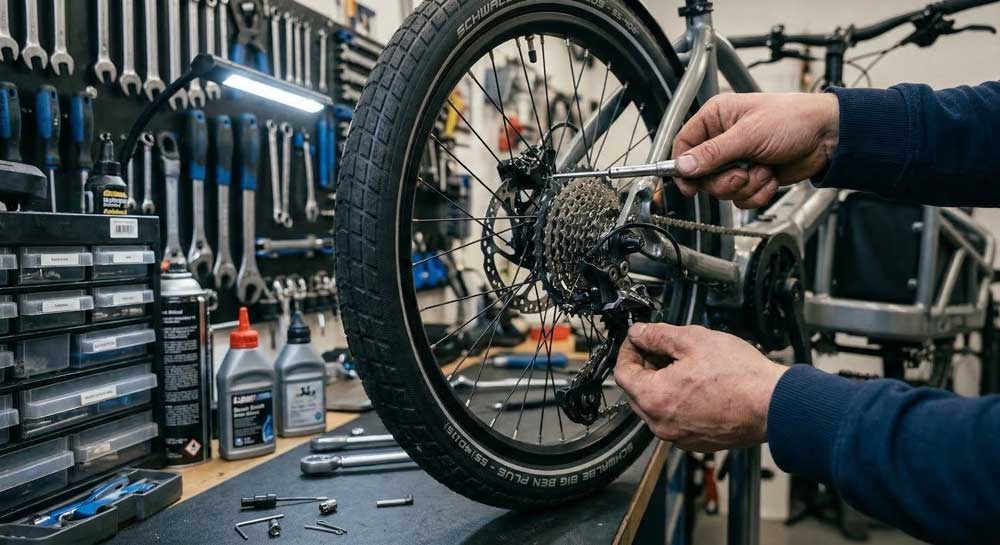
- Bleed — if air enters the hydraulic circuit (typically after a crash or brake line damage), the system must be bled. This removes air from the fluid and restores firm lever feel. Most bike shops handle this in under an hour.
For riders without mechanical confidence, the practical difference is: hydraulic systems require less frequent maintenance but the maintenance they do require is a workshop visit rather than a home adjustment. For most cargo bike owners riding in urban environments, this means one or two service visits per year rather than monthly cable adjustments.
How Aitour Cargo Bikes Implement Hydraulic Disc Brakes
All Aitour cargo bikes are equipped with high-quality hydraulic disc brakes. Bengal CBS (Combined Braking System) — available on some Aitour models — adds a linked front-rear braking function: applying the rear brake lever automatically activates both front and rear calipers in a calibrated proportion. This mirrors the principle behind motorcycle CBS systems. The practical benefit on a loaded cargo bike is significant: it reduces stopping distance and maintains vehicle stability by ensuring braking force is distributed across both wheels, even when a rider instinctively reaches for only one lever. It requires no power supply or sensors, making it mechanically reliable.
Across the Aitour range:

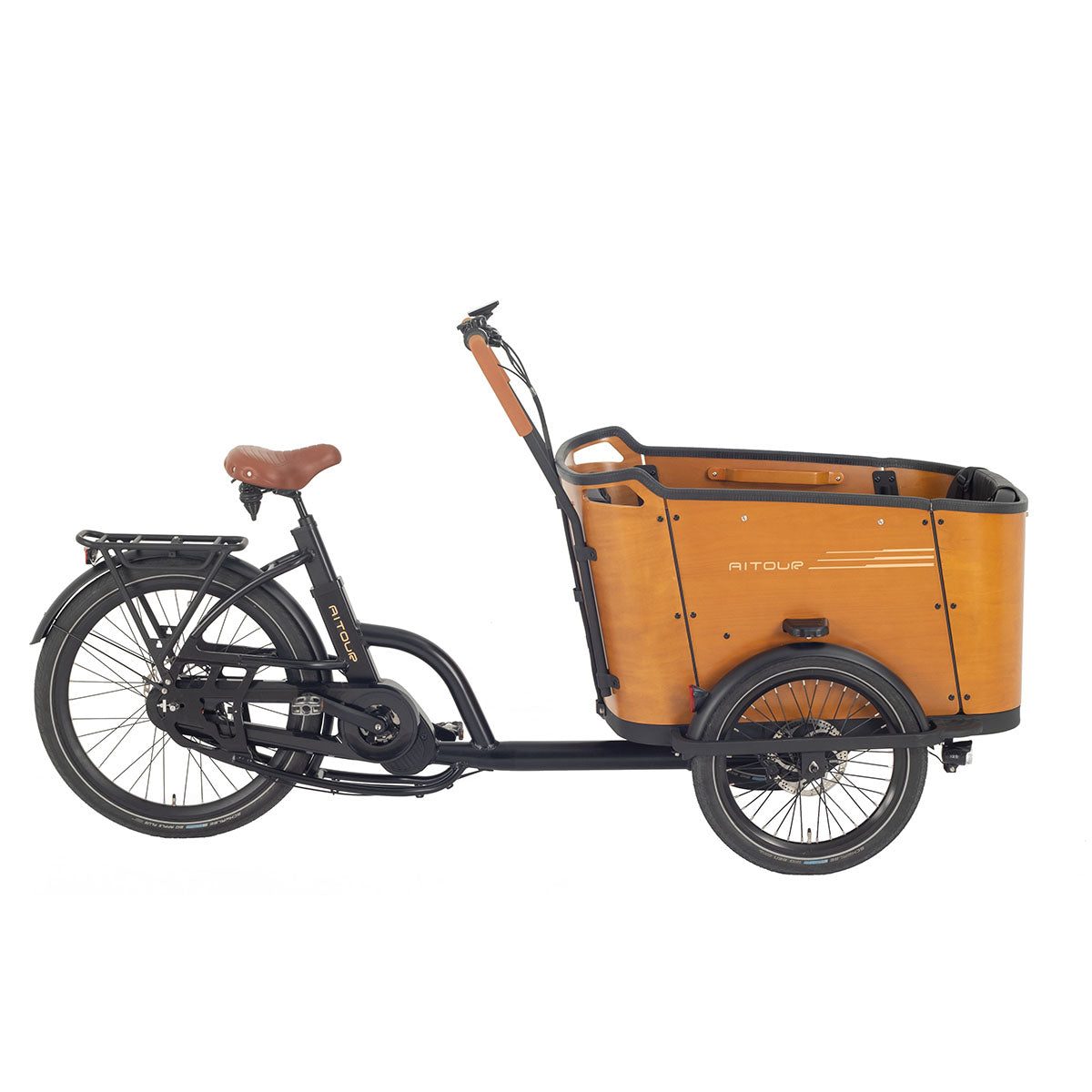
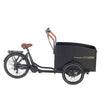
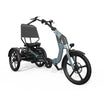
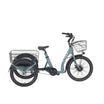
Family C and Family S (three-wheeled front-loading cargo bikes for families) use Bengal hydraulic disc brakes with a safety parking function, complemented by German-made clamper dampers that contribute to braking stability. The Family C's motor delivers up to 120Nm of torque, which—combined with TUV-tested frame construction and hydraulic brakes—means the complete system is matched: power and stopping power are specified together rather than treating brakes as an afterthought.
Basalt (two-wheeled urban cargo bike) uses Bengal hydraulic disc brakes with safety parking function across its 20" front and 26" rear Kenda tyres. The slim two-wheel design keeps the bike maneuverable in city traffic, and the hydraulic system ensures that maneuverability isn't purchased at the expense of stopping performance when loaded.
Questions Buyers Often Ask About Cargo Bike Brakes
Is hydraulic better than mechanical disc for a cargo bike? For loaded cargo bikes, yes. The higher clamping force, better wet-weather consistency, and self-adjusting pad clearance all matter more on a heavy loaded bike than on a lightly loaded commuter. Mechanical disc brakes are a reasonable choice on unloaded bikes where simplicity and field-repairability are priorities; they are a compromise on a bike regularly carrying 50–60kg of cargo or children.
Do hydraulic brakes work in the rain? Better than any alternative. The sealed circuit maintains consistent fluid pressure regardless of water ingress. Wet-weather performance is one of the primary reasons hydraulic systems are specified for cargo bikes in northern European markets.
What happens if a hydraulic brake line is cut or damaged? The brakes fail on that wheel. This is the main practical disadvantage versus mechanical cables, which can be field-repaired with basic tools. Hydraulic line damage requires a workshop visit. In practice, hydraulic lines on cargo bikes are routed through the frame and are not particularly vulnerable to everyday damage.
Can I upgrade from mechanical to hydraulic brakes on a cargo bike? In principle yes, but it requires replacing levers, calipers, lines, and rotors—and potentially the brake mounts on the frame. On a cargo bike where hydraulic brakes are specified from the factory, all of this is already matched to the frame geometry and load requirements. Retrofitting is a more complex and costly project.
What is the parking brake for? To hold the bike stationary on an incline without continuous hand pressure. It is particularly important for front-loading cargo bikes where a loaded cargo box exerts significant rolling force. It should be standard equipment on any cargo bike you're evaluating for family or grocery use.
Summary: What to Check on a Cargo Bike's Brake Specification
When evaluating any cargo bike purchase, these are the brake-specific questions worth asking:
- Are the disc brakes hydraulic or mechanical? (Hydraulic is the correct answer for a loaded cargo bike.)
- What brand and origin are the calipers? (Taiwan-made components from established manufacturers like Bengal are a reliability indicator.)
- What rotor size? (180mm minimum for loaded urban cargo use.)
- Is there a parking/hill-hold function? (Essential for front-loading designs and any inclined terrain.)
- What fluid type does the system use? (DOT or mineral oil—never mixed—and confirm parts availability in your region.)
Brakes are the last line between a controlled stop and an accident. On a bike carrying children, pets, or a weekly shop through urban traffic, they deserve the same attention as motor power and battery range.


Hinterlasse einen Kommentar
Alle Kommentare werden vor der Veröffentlichung geprüft.
Diese Website ist durch hCaptcha geschützt und es gelten die allgemeinen Geschäftsbedingungen und Datenschutzbestimmungen von hCaptcha.